
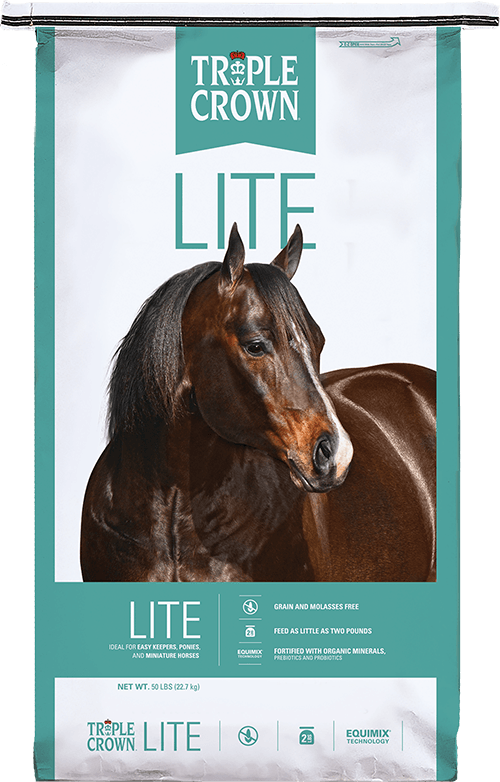
Triple Crown Lite
Ideal for ponies, miniature horses and easy keepers
%
Crude Protein
%
Max Crude Fiber
%
Crude Fat
Overview
A grain and molasses free, highly fortified pellet feed. Ideal for ponies, miniature horses and easy keepers, as well as horses with insulin resistance, metabolic disease, founder/laminitis and Cushing’s.
A reduced-calorie, high fiber pelleted diet perfectly balanced for ponies, miniature horses and mature horses that have a tendency to become over- conditioned (easy keepers), which includes many horses diagnosed with Cushing’s. Thanks to its heavily fortified formula, two pounds of Triple Crown Lite provides the same amount of vitamins and minerals that are normally provided in five to eight pounds of competitor feeds.
Feeding Instructions
Triple Crown Lite is designed to be a palatable feed for horses that will provide a desired intake level of supplemental minerals and vitamins without encouraging excessive weight gains. Triple Crown Lite should be fed to horses that have a tendency to become overweight or are receiving less than 4 pounds of grain per day. Triple Crown Lite should be fed in combination with hay and/or pasture, salt, and fresh, clean water. If your horse is being fed more than 5 pounds of grain daily in order to maintain desired body condition, Triple Crown Lite is not recommended.
MATURE HORSES: Feed 1-2 pounds of Triple Crown Lite per 500 pounds of body weight per day. If more than 4 pounds of Triple Crown Lite is required to maintain the horse’s desired body condition a switch to another Triple Crown formulation such as Low Starch may be necessary.
PONIES AND MINIATURE HORSES: Feed 1 pound of Triple Crown Lite per 500 pounds of body weight and adjust feeding rate to maintain desired body condition.
CAUTION: In order to avoid excessive mineral and vitamin intake, DO NOT feed more than 5 lbs. of Triple Crown Lite per day. Chronic intake of excess minerals and / or vitamins can adversely affect the health of your horse.
NOTE: Provide plenty of fresh, clean water at all times. Keep product fresh in cool, dry storage. Examine product daily for mold or insect contamination. DO NOT use product that is old, molded or insect contaminated.
Ingredients
Main Ingredient
Probiotic
Common Sensitivity
Guranteed Analysis
***The following coefficients of variation (cv) can be associated with the carbohydrate analyses. These should reasonably account for both sampling and analytical variation, though as you know, poor sampling can lead to much larger variation. The coefficients of variation (cv) for starch is 10%, WSC is 15% and ESC is 15%. For example, a feed with a WSC value of 10% should be expected to range from 8.5 – 11.5% and a WSC value of 20% to range from 17 – 23%. In addition, there are variables on ingredients between suppliers that could be as much as an additional 5% to 10% per ingredient. Therefore, products, such as TC 30% Supplement potentially would have a smaller variation than TC Lite due to the number of bulk ingredients making up the feed (2 vs. 4).